

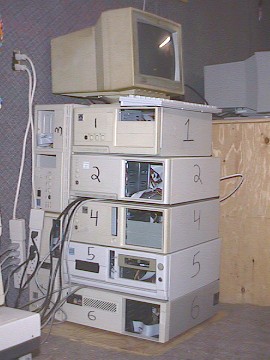

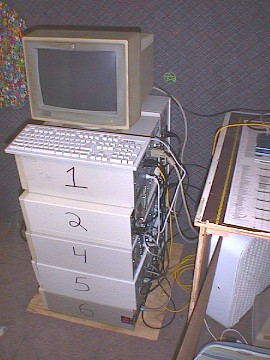

This shows ENKI, my Beowulf style cluster supercomputer. Well, okay, it doesn't seem all that super, since it performs between a Pentium 200MMX and a PII-400, depending on communication overhead... But, consider that it cost under $70 per node, and scales almost linearly for the same cost. Do that with your new PII-450.
ENKI's name comes from the Sumerian god, of the same name. To
badly plaguerize:
Enki was the Sumerian water-god, located at Eridu. Contrary to the
translation of his name, Enki is not the lord of the earth, but of the
Abzu (the watery abyss) and of wisdom. This contradiction leads Kramer
and Maier to postulate that he was once known as En-kur, lord of the
underworld or Kur, which either contained or was contained in the
Abzu. He did struggle against Kur as mentioned in the prelude to
"Gilgamesh, Enkidu, and the Underworld", and presumably was
victorious and thereby able to claim the title "Lord of Kur". He
is a god of water, creation, and fertility. He also holds dominion
over the land. He is the keeper of the Me, the divine laws. The Me
were assembled by Enlil in Ekur and given to Enki to guard and
impart to the world, beginning with Eridu, his center of worship.
From there, he guards the Me and imparts them on the people. He
directs the Me towards Ur and Meluhha and Dilmun, organizing the
world with his decrees.
ENKI (the cluster) exists as a Beowulf style cluster supercomputer composed of 7 nodes, each a 486DX2/66 with 8Mb of main memory, 64Mb of swap space, and 128kb L2 cache. It runs Slackware v3.5 (2.0.34 Linux kernel), and uses the MPICH package for parallel program execution. Networking uses plain old 10-base-2, since I didn't want to buy a new hub.
For performance graphs of ENKI vs. a Pentium 200MMX, click
here.
For a general project writeup, click here.